Large-Scale Aquifer Simulation
Large-scale aquifer simulation bridges the critical gap between bench-scale laboratory experiments and field-scale implementation, providing site-specific planning and optimization before capital-intensive deployment.
By replicating the subsurface in a transparent, physical flow chamber, the model makes reagent injection, reactive mass transport, and biodegradation directly observable. This drastically reduces geological uncertainty and streamlines on-site execution.
The empirical data obtained from the simulation provides an indispensable engineering basis for defining well spacing, screen intervals, injection sequencing, reagent dosage and volume, operational pressure limits, and real-time monitoring strategies.
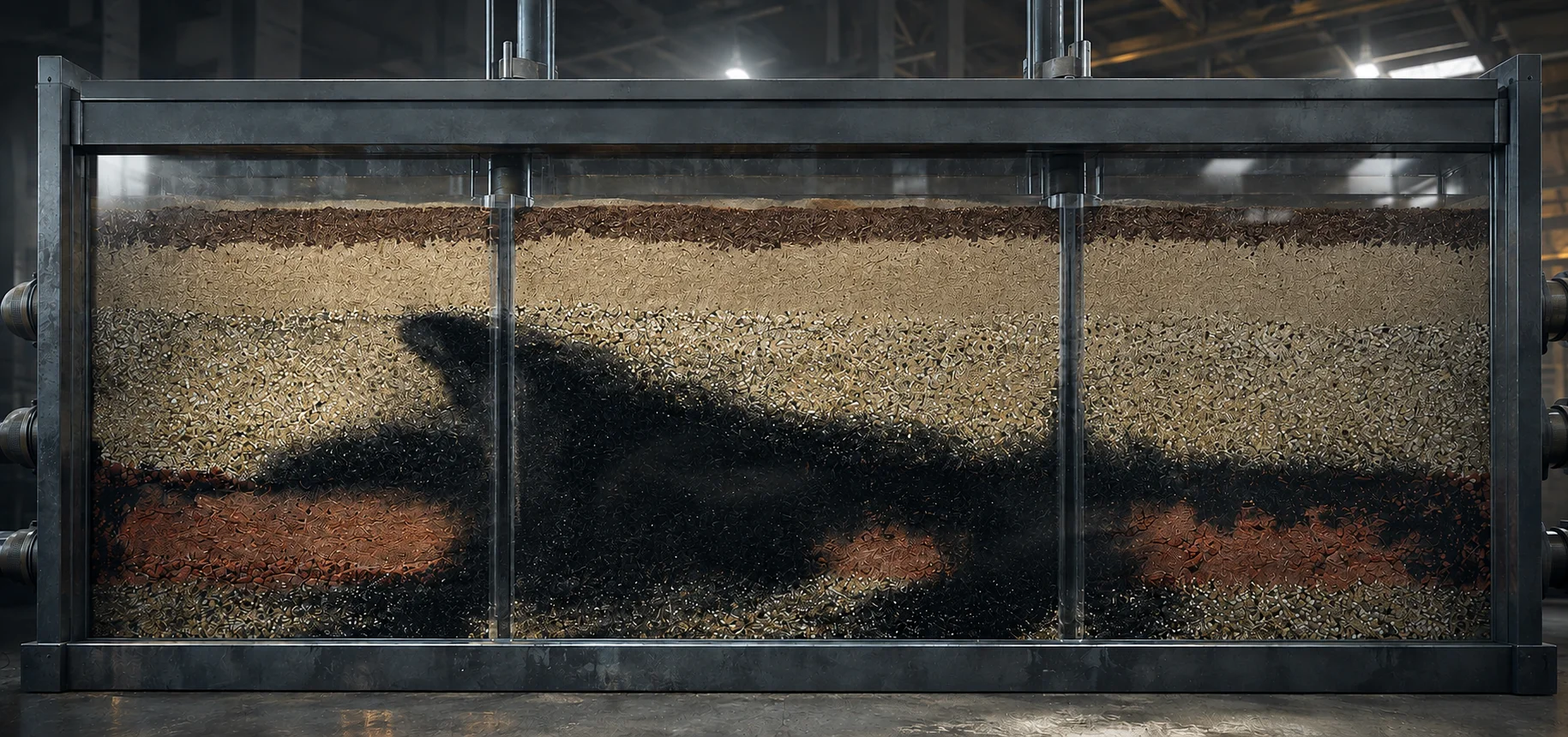
Conceptual representation of a large-scale aquifer test facility: True-to-scale geological stratification reconstructed from borehole logs, scaled model wells, controlled hydraulic flow gradient, and spatio-temporal plume dispersion of in-situ remediation amendments.
How the Physical Aquifer Model Operates
Large-scale aquifer simulations—frequently termed flow-tank or aquarium tests—reconstruct selected hydrogeological site characteristics within a strictly controlled, observable environment.
The test bed is packed with original, site-specific soil and groundwater. During sampling, transport, and stratified packing, the native physical, geochemical, and microbiological characteristics are preserved to the highest practical standard.
Using detailed borehole logs and stratigraphical records, the subsurface is reconstructed to an exact scale. The physical model reproduces layering sequence, bed thickness, grain size distribution, high-permeability channels, low-permeability silt/clay lenses, and preferential flow paths. This results in an authentic, site-specific physical representation of the aquifer—rather than an arbitrary, idealized sand box.
Investigation Dimensions in the Large-Scale Subsurface Model
Site soil and groundwater are positioned to mirror the interpreted geological profile, purposefully incorporating natural subsurface heterogeneities.
Model wells are engineered to true geometric scale. Diameter, depth, screen intervals, and placement directly replicate full-scale field specifications.
A controlled hydraulic gradient is established across the tank to simulate realistic seepage velocities, flow vectors, and groundwater residence times.
Horizontally and vertically staggered inline sensors and sampling ports monitor the dynamic migration of the injected reactive front over time.
Continuous In-Line Monitoring During Simulation
To produce legally defensible data for authorities, engineering consultants, and corporate decision-makers, the facility is equipped with comprehensive real-time instrumentation:
When is a Large-Scale Aquifer Simulation Essential?
Subsurface flow models are especially vital for complex stratigraphic environments, thin or strongly heterogeneous aquifers, and challenging contamination matrices (such as DNAPL source zones, PFAS plumes, or complex solvent cocktails). Pre-validating the remediation design in a physical pilot model prevents dry holes, hydraulic short-circuiting, and reagent misallocation in the field—saving substantial capital expense.
Ready to eliminate subsurface uncertainty before full-scale deployment?
Contact our senior engineering team to discuss a tailored aquifer simulation study for your site.